Reading the Desert: A Thoughtful Journey through Namibia
Namibia rewards attention to scale. A mountain that looks close can remain on the horizon for an hour, while a patch of shade beside a dry riverbed can become the most memorable stop of the day.
A journey with room to notice
Namibia rewards attention to scale. A mountain that looks close can remain on the horizon for an hour, while a patch of shade beside a dry riverbed can become the most memorable stop of the day. The country is often presented as a collection of enormous landscapes, yet the experience depends on small decisions: when to leave, where to sleep, and how much distance to attempt between stops. A satisfying desert journey leaves room to notice both the land and the work required to travel through it.
Start with the shape of the route
Windhoek is a practical point from which to think about the interior, rather than a reason to hurry straight onto the road. The central highlands, the Namib Desert, and the Atlantic coast form very different travel environments. Sketch a route that moves between them in manageable stages, allowing overnight stops to do some of the work that a long return drive would otherwise demand.
Build the route from the overnight stops outward. If the desert is the central reason for traveling, give the Sesriem area enough nights that an early outing does not follow a long arrival. If rock art and northern landscapes matter more, reduce the southern extension. Namibia’s geography makes compromise productive: the time recovered by omitting one distant region can become an extra morning in a landscape you would otherwise barely see. A larger loop is worthwhile only when the available days support its actual road stages.
Give Sossusvlei an unhurried morning
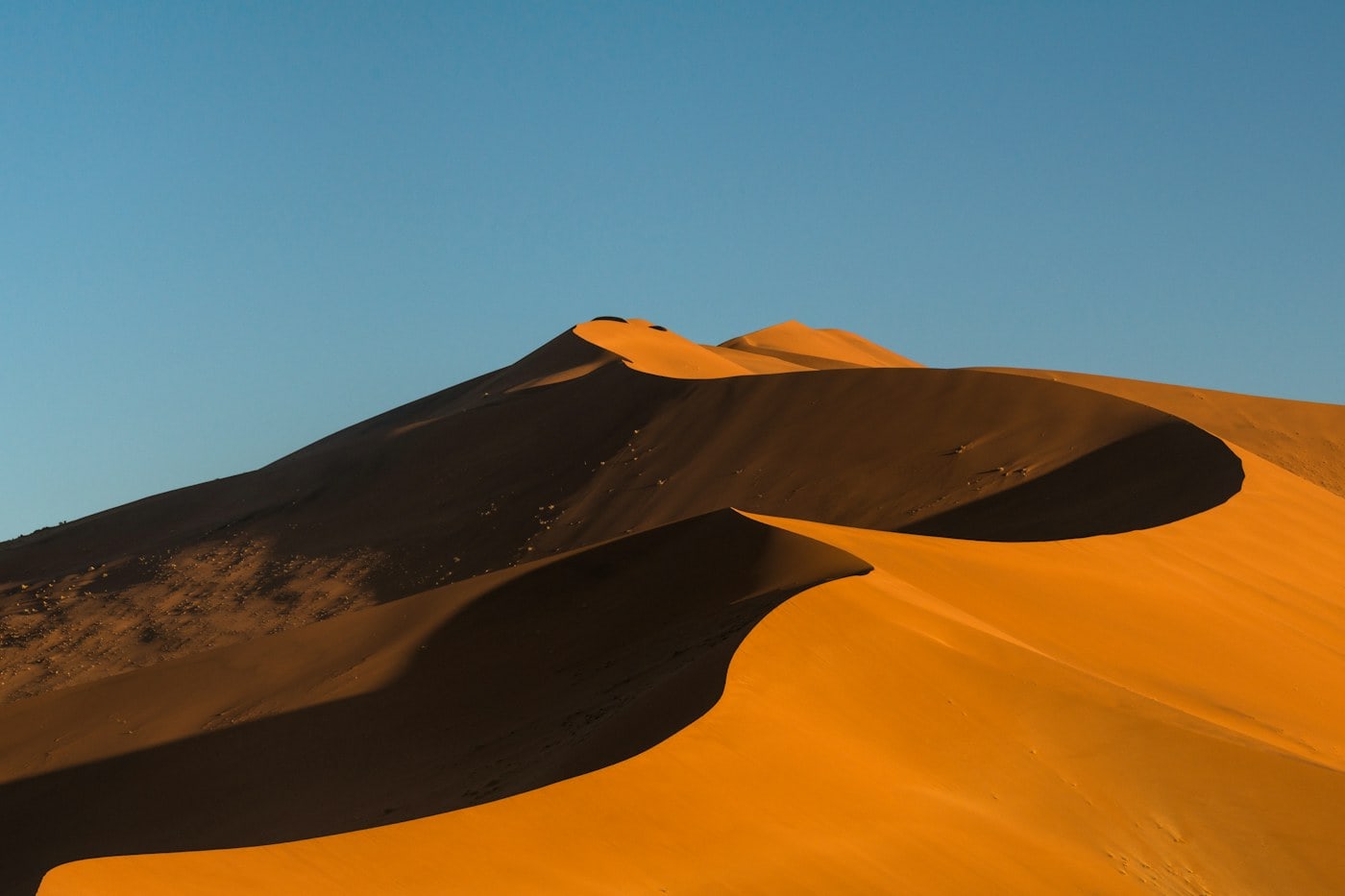
Sossusvlei lies within the Namib sand sea, with Sesriem serving as the familiar access area. The striking contrast is not simply red sand against blue sky: dune ridges, pale pans, and occasional trees create changing layers of texture. Treat sunrise as the beginning of an outing rather than a deadline that justifies an exhausted drive. Access arrangements and the suitability of a vehicle need checking before travel.
Dunes are easiest to appreciate when you notice their structure rather than search for the highest ridge. The windward face, sharp crest, and steeper slope give a single dune several different appearances. Watch how people on a permitted route reveal scale without making their presence the subject of every image. A distant line of walkers can help explain the size of the sand sea, but it is not a reason to copy a route without checking that it is open and suitable.
Look beyond the postcard at Deadvlei
The dark standing trees and pale clay surface at Deadvlei are widely photographed, but the approach is part of the landscape. Sand changes the effort required to walk, and the absence of nearby shade matters more than a short distance suggests. Stay on the permitted route, respect closures, and avoid climbing or handling old trees. A less crowded view often comes from patience rather than pushing farther into fragile ground.
A wide view and a close view tell different stories at Deadvlei. From farther back, the pan reads as a pale opening among dunes; nearer the permitted approach, individual tree forms become more prominent. Give both perspectives a moment. Walking on sand can make a seemingly simple photographic outing demanding, so do not use the farthest possible viewpoint as the measure of success. The shape of the setting is often clearer when you stop moving and allow the eye to separate its layers.
Use the coast as a change of pace
Swakopmund and Walvis Bay offer an Atlantic counterpoint to the inland desert. Marine air, broad streets, and waterfront space change the rhythm after days of sand and gravel. They are also places for restocking and taking a shorter day. Do not assume that the coast will feel as warm as the interior; its conditions deserve a separate look when deciding what to wear and how to organize a walk.
Swakopmund’s built streetscape and Walvis Bay’s working waterfront provide a useful reminder that the coast is not just a climatic break. Choose the town activities that interest you instead of filling the interval with another long excursion. A promenade walk, practical errands, and a slow lunch can restore energy for the next stage. If arranging a marine or lagoon outing, ask about the operator’s approach to wildlife, current conditions, and the exact nature of the activity before committing.
Take Damaraland seriously as a landscape
Damaraland is best approached as a region of changing rock, settlement, and distance, rather than a single attraction to tick off. Around Twyfelfontein, rock engravings make the cultural history of the landscape especially important. Follow the official visitor arrangements and guided-access requirements. Interpretation adds more than another photograph, because it helps distinguish meaningful historical marks from a scenic surface viewed without context.
Twyfelfontein’s engravings are not simply patterns to identify from a checklist. Their placement within the rock landscape and the interpretation offered on an official visit help distinguish the site from a general scenic stop. Listen for what is known, what is inferred, and where uncertainty remains. Avoid touching surfaces or asking a guide to move beyond visitor boundaries. When the cultural visit is the main purpose of the day, there is no need to dilute it with a string of distant minor stops.
Make driving days realistic
A line on a map says little about the effort of a gravel-road day. Surface conditions, corrugations, visibility, and the need for fuel or a meal can change the practical meaning of distance. Ask the rental provider about the intended route and vehicle restrictions, and consult current road information. Build the day around reaching an overnight base comfortably, with daylight available for the final approach.
Think about luggage, fuel, water, and communications before the vehicle leaves the main service point. The correct arrangements depend on the rental agreement and intended route, so use the provider’s guidance rather than borrowing a packing list from a very different journey. Keep a record of your overnight destination and the practical contact details. Long empty stretches can be beautiful, but they are easier to enjoy when basic logistics have already been handled and the arrival does not depend on optimistic timing.
See wildlife without making promises
Desert-adapted wildlife belongs to a living environment, not a guaranteed viewing schedule. If wildlife is a priority, choose responsible local expertise and ask how outings avoid disturbing animals. Never pursue an animal for a photograph or treat a water source as a place to crowd. A quiet observation from an appropriate distance can be more valuable than moving constantly in pursuit of an expected image.
Ask what an outing involves before equating a wildlife label with a suitable experience. Driving time, walking terrain, group size, and the guide’s decisions all affect the day. A responsible operator should be able to explain how visitors avoid changing an animal’s behavior. Appreciate tracks, habitat, and the wider landscape even if a particular species does not appear. A journey that remains interesting without a guaranteed sighting places less pressure on guides and animals to deliver an unrealistic promise.
Leave with a coherent memory
The strongest Namibia itinerary usually has a clear sequence: an introduction to the highlands, time in the desert, a coastal interval, and perhaps a further northern region if the available days support it. Removing a distant stop can improve the trip more than adding another attraction. Keep one evening free from a complicated arrival, so that the silence and changing light can be experienced without the pressure of the next task.
On the final desert evening, choose a simple place where stopping is permitted and no further travel is necessary. Notice the change from warm light on stone to the softer outlines that follow. A journal entry about distance, texture, and the day’s decisions can hold more than another wide-angle picture. The lasting impression of Namibia often comes from the relationship between movement and stillness: the hours spent crossing a landscape, and the moment when there is finally no need to move through it.
A route built around overnight places
For a first desert-focused visit, think in blocks rather than a rigid daily race. Use Windhoek for arrival and practical arrangements, then place the desert stay before a coastal interval. If adding Damaraland, give it a separate portion of the journey rather than using it as a distant detour from the coast. The sequence can be adapted to the actual time available, but each region should receive enough space to justify the travel required to reach it. Do not attach a far northern extension merely because it completes a satisfying shape on a map.
Within those blocks, distinguish between a transfer day and a landscape day. The transfer can include an appropriate short stop, but it should not depend on fitting several walks around a long drive. The landscape day should begin from a nearby base, with the main outing selected according to current access and conditions. That distinction is especially useful at Sesriem, where an early desert visit is far easier when the previous evening has been straightforward. It also helps preserve coastal rest time instead of consuming it in the attempt to catch up.
Keep an internal trip note with the actual place names, accommodation contacts, vehicle guidance, and the source of current access information. This is more useful than a long list of scenic adjectives. Afterward, the note can become a record of how the journey unfolded: which road took longer, which landscape held your attention, and which omitted stop you would genuinely return for. A Namibia trip does not need to cover the whole country to feel substantial. It needs a route that supports the scale and stillness of the places it does include.