A Day in Vienna’s Coffeehouses and the Streets Around Them
A Vienna coffeehouse can be a place to read, talk, or watch the room gradually change. It works less well as a landmark to photograph before rushing to the next one.
A different way to arrive
A Vienna coffeehouse can be a place to read, talk, or watch the room gradually change. It works less well as a landmark to photograph before rushing to the next one. Plan a day around one long café stop and a small area of the city, letting architecture and public spaces provide the connection. The purpose is not to identify a single definitive coffeehouse, but to discover which kind of room suits the way you want to spend an hour.
Decide what you want from the room
Some coffeehouses are grand and ceremonial; others feel more compact and neighborhood-oriented. A celebrated name may come with a queue and a busier atmosphere. Think first about whether you want to read, have a conversation, or enjoy the interior. The answer can matter more than the reputation of the address. Check opening information directly when a particular café is central to the day, and keep a nearby alternative.
Choose a place where you will be comfortable ordering and sitting, rather than spending the entire morning waiting for a room that does not match your mood.
Learn the ordering rhythm
Menus in Vienna often use coffee names that deserve a moment of attention. Read before ordering and ask staff when a description is unfamiliar. A coffee and a pastry may be enough for a light pause, while a longer visit may call for something more substantial. Follow the service style of the room rather than assuming you should order at a counter. Busy staff appreciate a clear decision and a little patience.
Keep the menu close until the order is settled, and let a first drink establish whether you want a brief stop or a longer seated visit.
Walk the Ring as a frame
The Ringstrasse gives a useful architectural frame to the inner city. Its broad spaces and major buildings feel different from the smaller streets within. Choose a short section connected to the coffeehouse rather than attempting the entire circuit in one walk. Notice changes in scale between a public building, an adjoining park edge, and the next street. Crossings and tram routes require attention even when the architecture draws the eye upward.
Pick two recognizable buildings as endpoints and use the walk between them to understand the boulevard rather than merely collect facades.
Use smaller streets inside the center
The inner city contains busy shopping streets and quieter connections, sometimes only a turn apart. A slow loop can be organized around a square, a church exterior, or a bookshop. Keep expectations modest: quieter does not necessarily mean hidden, and access to courtyards is not automatic. Respect private entrances and any restrictions on photography. A street’s curve, paving, and building proportions can provide enough interest without entering an interior.
Make the loop easy to shorten if weather changes or the café visit runs longer than expected.
Give one museum a defined role
Vienna’s major art collections can consume an entire day, so choose carefully if combining one with a coffeehouse outing. Select a collection or exhibition that genuinely interests you and consult the institution’s current arrangements. A focused visit is better than moving rapidly through many rooms. Leave time afterward for an uncomplicated walk or seated pause. Do not make an important museum visit depend on the uncertain timing of a famous café queue.
Book through the institution when appropriate and keep the museum’s entry time as the fixed point around which the rest of the day can flex.
Consider a neighborhood beyond the monumental center
A district outside the most familiar central circuit can offer shops, cafés, and daily street life at another scale. The area around Neubau is one possible direction, depending on where you are staying. Rather than assume every small café is a historic institution, enjoy each business for what it offers now. A modern coffee bar and a traditional coffeehouse serve different kinds of visits, and both can fit a Vienna itinerary.
Choose a compact cluster of streets near a straightforward transit connection, with one optional shop or gallery instead of a long speculative list.
Notice how an hour changes a café
Once seated, pay attention to the room beyond its decorative details. Tables turn over, light shifts across windows, and the sound of conversation changes as different customers arrive. Reading a few pages or writing a postcard can make the stop feel less like a performance of leisure. Be considerate with laptops, calls, and photographs, especially in a room built for conversation. Ask before taking close pictures of staff or customers.
Order in keeping with the length and setting of the visit, and remain aware when a busy room has people waiting for tables.
End with a walk instead of another queue
After a generous café stop and a focused cultural visit, a short evening walk may be enough. Choose a public square or park edge near the route home. Vienna’s monumental scale becomes easier to appreciate when it is balanced by small observations: a doorway, a shop sign, or a tram passing through a broad junction. A second famous coffeehouse is optional, not a requirement for understanding the city.
Leave time for a proper meal and a simple return connection, keeping the last part of the day as relaxed as the first café pause.
Architecture that connects the coffeehouse day
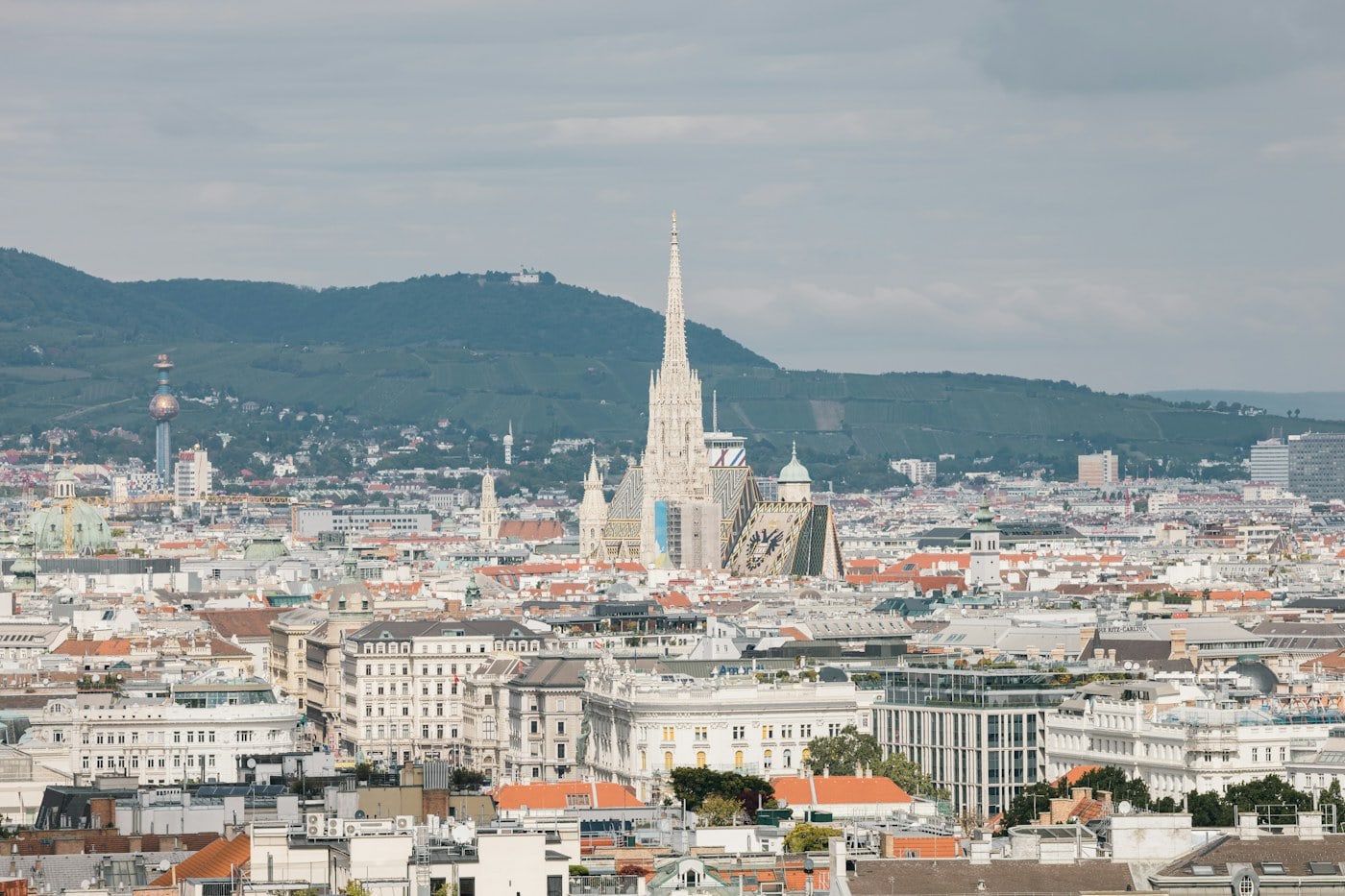
The Ringstrasse can be sampled through a short section near buildings that interest you. The State Opera, the Kunsthistorisches Museum area, the Parliament, and the Rathaus belong to different architectural moments and functions, so there is no need to treat them as a single continuous photo assignment. Select two nearby anchors, look at their relationship to the boulevard and public space, and use crossings carefully. A coffeehouse stop before or after this walk provides a change from the scale of the street to the scale of a room. That contrast is often more memorable than another long circuit.
Inside the older center, the area around Stephansplatz gives an obvious orientation point, but smaller streets can provide the more relaxed walking. Choose a short route toward a square such as Judenplatz or through streets whose layout suits the day. Do not assume that an inviting archway leads to public access. When considering an interior, check the institution’s own visitor arrangements and give it a defined role. A church, an art museum, and a café ask for different kinds of attention. Keeping one of them as the main focus prevents the rest from feeling like hurried intervals between entries.
For a neighborhood extension, the MuseumsQuartier and the streets toward Spittelberg offer a useful change in scale from the Ring. Cultural buildings, courtyards, shops, and smaller streets can support a compact afternoon without a distant transfer. Current exhibitions and opening arrangements should determine any indoor visit. A coffee stop here may feel different from a formal central coffeehouse, and that difference is worth noticing without declaring one experience superior. On the menu, a Melange is a familiar Vienna coffee choice, but descriptions and preparations can vary by establishment. Ask when unsure and choose according to taste rather than the need to perform a particular ritual. The city’s coffeehouse culture becomes most enjoyable when it supports real conversation, reading, and rest within an otherwise thoughtful day of walking.
A pastry can give a coffeehouse stop a different shape from a full meal. Apple strudel, for example, belongs to the familiar range of Vienna café choices, but the menu and preparation are the establishment’s own. Read the description and order what appeals rather than seeking a supposedly definitive version. If a larger lunch is needed, decide that before settling into a place that mainly suits drinks and sweets. Keeping the food choice realistic leaves the pause relaxed. It also makes it easier to continue to a museum or short walk without immediately searching for another stop because the first order did not match your appetite.
What to do with the hour you have made
The simplest way to enjoy a coffeehouse is to give the visit an ordinary purpose. Bring something to read, write a few notes about the morning, or have an unhurried conversation. That purpose prevents the room from becoming merely a backdrop. Look at how the tables are arranged and choose a seat that suits the intended visit without occupying more space than necessary. When the café is busy, remain aware of staff and waiting customers. A long pause is most comfortable when it fits the room’s service and the amount you order, rather than feeling like a claim on a famous seat.
The walk before or after can be equally modest. A short Ringstrasse section establishes the larger architectural frame, while smaller inner-city streets offer a different scale. Pick a few details to notice: the transition from a broad boulevard into a narrow street, the shape of a public entrance, or the view across a square. These observations help connect the café’s interior world to the city outside. You do not need to enter every important building to understand that relationship. One museum or cultural interior can be the day’s principal visit, with its current entry arrangements providing the fixed point in an otherwise flexible schedule.
For another day, try a neighborhood café beyond the monumental center and compare the experience without ranking one as more authentic. A contemporary coffee bar may encourage a shorter visit, while a traditional room may invite a different pace. Both serve real people and reflect different parts of Vienna. The comparison is useful when it clarifies what you enjoy: a quiet table, a lively counter, a pastry, a view of the street. End with a proper meal or a straightforward walk home rather than another queue. The memory of the day is likely to be a combination of room, conversation, and street, not the number of coffeehouse names you managed to collect.